How to Write an Essay That Gets Noticed: The Hamburger Method Explained
A practical guide for parents and learners
Does your child stare at a blank page when asked to write an essay? Do they struggle to organise their thoughts, know where to start or decide what to include?
Essay writing does not have to be a frustrating experience. In fact, once learners understand how an essay is structured, writing becomes much easier.
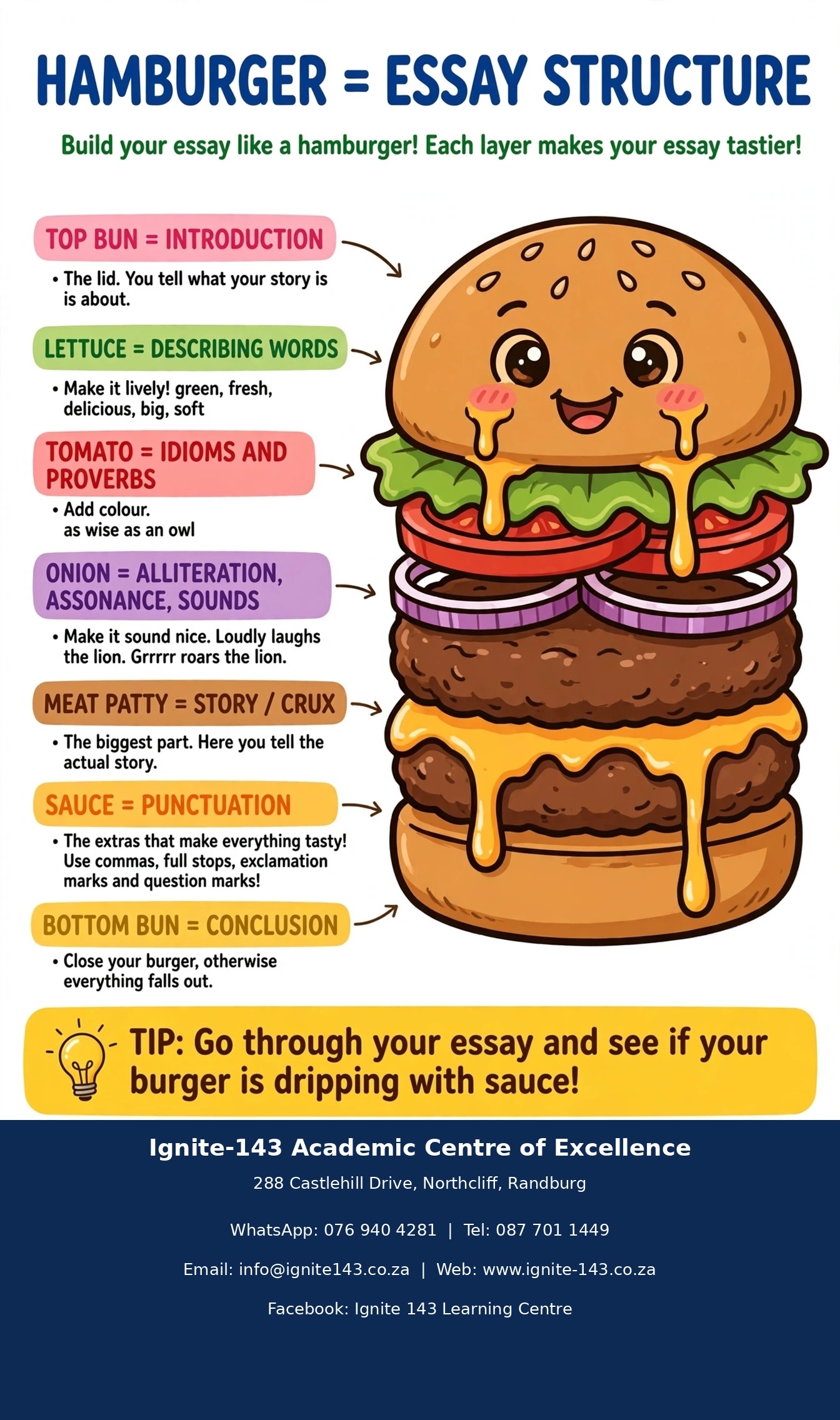
At Ignite 143 Academic Centre of Excellence, we believe that learning should be practical, engaging and easy to understand. One of the simplest ways to teach essay writing is by using the Hamburger Method.
Just like a hamburger has different layers that work together to make a complete meal, an essay has different parts that work together to create a well structured piece of writing.
Let's break it down and put it into practice!
1. Understanding the Hamburger Method
Before your child starts writing, they need to understand what each part of the hamburger represents.
TOP BUN: Introduction
The introduction is the beginning of your essay. It introduces the topic and gives the reader an idea of what the story will be about.
Think of it as inviting someone to read your story.
Practical tip: Start with an interesting opening sentence. Avoid beginning every essay with "I am going to tell you about..."
Instead, try:
- I could hardly believe my eyes!
- It was a morning I would never forget.
- Little did I know that this day would change everything.
LETTUCE: Describing Words
Describing words, also known as adjectives, help bring your writing to life.
Instead of saying:
"The dog was big."
Try:
"The enormous, fluffy dog bounded across the garden."
Encourage your child to use words that describe what they could see, hear, smell, taste and feel.
Practical tip: Ask your child to describe a place or person using at least three interesting adjectives.
TOMATO: Idioms and Proverbs
Idioms and proverbs add colour and character to writing.
An idiom is an expression that has a meaning different from the literal meaning of the words.
Examples:
- It was raining cats and dogs.
- I was over the moon.
- Time flies when you are having fun.
- Every cloud has a silver lining.
A proverb is a well known saying that teaches a lesson or gives advice.
Examples:
- Actions speak louder than words.
- Where there is a will, there is a way.
- Practice makes perfect.
Practical tip: Encourage your child to include one suitable idiom or proverb where it fits naturally. Using too many can make an essay sound forced.
ONION: Alliteration, Assonance and Sound Devices
These techniques make writing more interesting and memorable.
Alliteration is the repetition of the same beginning consonant sound.
Example: "The beautiful blue butterflies danced above the bright flowers."
Assonance is the repetition of vowel sounds in nearby words.
Example: "The light of the fire shone brightly."
Practical tip: Challenge your child to create one sentence using alliteration. It is a fun way to expand their vocabulary and develop creativity.
MEAT PATTY: The Main Story
This is the biggest and most important part of the essay.
Here, your child develops the main events, explains what happened and adds details.
The story should have a logical sequence:
- What happened first?
- What happened next?
- What was the most exciting or important moment?
- How did everything end?
Practical tip: Encourage your child to write several paragraphs for the main body rather than squeezing the entire story into one long paragraph.
SAUCE: Punctuation
Punctuation helps the reader understand the writing.
Teach your child to use:
- Full stops to end sentences.
- Commas to separate ideas or items in a list.
- Question marks when asking questions.
- Exclamation marks to show strong emotion.
- Speech marks when writing dialogue.
Practical tip: After writing each paragraph, ask your child to read it aloud. This often helps identify missing punctuation and sentences that do not make sense.
BOTTOM BUN: Conclusion
The conclusion brings the essay to an end.
It should wrap up the story and leave the reader with a final thought or feeling.
Avoid introducing a completely new event in the conclusion.
Practical tip: Ask your child what they learnt, how they felt or why the experience was important.
2. Let's Put It Into Practice!
Understanding the theory is one thing. Applying it is where the real learning happens.
We are going to use the following essay topic:
"A Day I Will Never Forget"
Imagine your child has been given this topic at school. Instead of immediately picking up a pen and starting to write, follow these three important steps.
STEP 1: Create a Mind Map
Before writing, learners should brainstorm their ideas.
A mind map helps organise thoughts and prevents learners from running out of ideas halfway through the essay.
Ask your child to think about a memorable day. It could be a birthday, a family outing, a sporting event, a holiday or even an unexpected adventure.
For our example, we will use:
A Surprise Birthday Adventure
The mind map could look something like this:
CENTRAL IDEA: A Day I Will Never Forget
1. Introduction
- My tenth birthday.
- Thought it would be an ordinary Saturday.
- Family told me we were going shopping.
2. Setting
- Beautiful sunny morning.
- Birds singing.
- Excited but curious.
- Family acting strangely.
3. Main Events
- Arrived at a theme park.
- Saw my friends waiting.
- Everyone shouted, "Surprise!"
- Went on exciting rides.
- Ate delicious birthday cake.
- Laughed with friends.
4. Most Memorable Moment
- Went on the biggest roller coaster.
- Felt nervous.
- Screamed all the way down.
- Wanted to go again!
5. Conclusion
- Best birthday ever.
- Felt loved and special.
- A memory I will treasure forever.
Parent's tip: Do not write the mind map for your child. Ask questions and let them come up with the ideas themselves. Write down their answers and help them organise the information.
Remember, there is no such thing as a silly idea during brainstorming!
STEP 2: Write the First Draft
Now that the ideas have been organised, it is time to turn them into sentences and paragraphs.
Explain to your child that a draft does not have to be perfect. This is where they get their thoughts onto paper.
They should concentrate on telling the story in the correct order.
Here is an example of what the first draft might look like:
A Day I Will Never Forget
It was my tenth birthday and I thought it was going to be a normal Saturday. My mother told me that we were going shopping. It was a sunny day and the birds were singing. Everyone seemed to be acting strangely.
When we arrived at the shopping centre, I saw that we were actually at a theme park. My friends were standing there waiting for me. Everyone shouted surprise. I was so happy because I did not know that they were coming.
We went on many rides and had lots of fun. The biggest roller coaster looked very scary. I was nervous but I decided to try it. I screamed all the way down. It was so exciting that I wanted to go again.
Afterwards, we ate birthday cake and played games. I had the best day ever.
I will never forget my tenth birthday because my family and friends made me feel very special.
Now, let's look at how we can improve this draft.
The story has a beginning, middle and end, which is a good start. However, we can make it more interesting by:
- Replacing ordinary words with more descriptive vocabulary.
- Adding an idiom.
- Including alliteration.
- Adding dialogue.
- Improving sentence variety.
- Checking punctuation.
- Making the reader feel as though they are part of the experience.
This is the purpose of editing. We are not changing the entire story. We are improving the way it is told.
STEP 3: Write the Final Essay
Now comes the exciting part!
We take the original draft, improve the vocabulary, add descriptive details and use the different layers of our hamburger to create a complete essay.
Here is what the final version could look like:
A Day I Will Never Forget
I could hardly contain my excitement! It was finally my tenth birthday, and little did I know that my family had planned the biggest surprise of my life. I thought it was going to be an ordinary Saturday, but I was in for a day filled with laughter, excitement and unforgettable memories.
The sun was shining brightly, the birds were singing sweetly and the beautiful blue sky stretched as far as the eye could see. My mother told me that we were going shopping. Something seemed a little strange, as everyone was whispering and exchanging secret smiles. I was as curious as a cat, but I had absolutely no idea what was waiting for me.
When we arrived at our destination, I could hardly believe my eyes. We were at a huge theme park! Suddenly, a group of familiar faces appeared from behind the entrance. "SURPRISE!" shouted my friends. I was over the moon! My family had secretly organised a birthday adventure and invited all my friends to celebrate with me.
We spent the morning exploring the park, laughing and enjoying the exciting rides. The colourful carousels spun around while children squealed with delight. However, the biggest challenge was still waiting for me. Standing in front of us was the enormous roller coaster, with its steep tracks twisting high into the sky.
My knees were shaking like leaves in the wind. "Are you sure you want to do this?" my best friend asked. I took a deep breath and replied, "Of course! How bad can it be?"
Well, I soon found out!
As the roller coaster climbed higher and higher, my heart raced like a speeding train. Suddenly, we plunged down the steep track. I screamed at the top of my lungs! It was terrifying, thrilling and absolutely amazing. Before I knew it, the ride was over, and I was already asking to go again.
Later, we enjoyed delicious birthday cake, played games and shared countless laughs. The day flew by, and before I knew it, it was time to go home.
As I climbed into bed that evening, I realised that the best presents are not always wrapped in colourful paper. Sometimes, the greatest gifts are the memories we create with the people we love. It truly was a birthday to remember, and I will treasure that special day for years to come.
3. Can You Spot the Hamburger?
Now that you have read the final essay, let's identify the different layers.
Hamburger layer Where it appears in the essay
Top bun: Introduction The first paragraph introduces the birthday surprise.
Lettuce: Describing words Beautiful blue sky, enormous roller coaster, colourful carousels.
Tomato: Idioms and proverbs Over the moon, curious as a cat.
Onion: Sound devices Beautiful blue sky, steep tracks.
Meat patty: Main story The arrival at the theme park, the surprise and the roller coaster.
Sauce: Punctuation Commas, full stops, exclamation marks, question marks and speech marks.
Bottom bun: Conclusion The final paragraph reflects on the experience and explains why it was special.
The important lesson: Every ingredient has a purpose. A good essay is not simply about writing as many words as possible. It is about using words effectively to communicate ideas.
4. How Can Parents Help Their Children Practise at Home?
Parents play an important role in helping children develop their writing skills. You do not need to be an English teacher to support your child's learning.
Here are some practical ways to make essay writing part of your home learning routine.
1. Start with interesting topics
Choose topics that your child can relate to.
Some ideas include:
- My Favourite Holiday.
- If I Could Have Any Superpower.
- The Best Day of My Life.
- An Unexpected Adventure.
- My Favourite Person.
- If I Could Change One Thing in the World.
- A World Without Technology.
For younger learners, choose familiar experiences. Older learners can explore more challenging topics that require imagination, description and critical thinking.
2. Never skip the mind map
One of the biggest mistakes learners make is starting to write without planning.
Spend five to ten minutes brainstorming ideas before writing. This simple habit can make a significant difference to the structure and quality of an essay.
3. Encourage vocabulary development
When your child uses an ordinary word, challenge them to think of another word with a similar meaning.
For example:
- Happy: delighted, cheerful, overjoyed.
- Big: enormous, gigantic, massive.
- Scared: frightened, terrified, anxious.
- Beautiful: stunning, breathtaking, magnificent.
A wider vocabulary gives learners more opportunities to express themselves.
4. Teach them to edit their own work
Do not immediately correct every mistake.
Ask questions such as:
- Does this sentence make sense?
- Have you used the correct punctuation?
- Can you replace this word with something more interesting?
- Have you explained what happened clearly?
- Does your conclusion bring the story to a satisfying end?
Allow your child to identify and correct mistakes. This develops independence and confidence.
5. Practise regularly
Writing improves with practice. One essay every few months is unlikely to develop the same skills as short, regular writing activities.
Try practising one essay a week. Rotate between narrative, descriptive, argumentative and discursive writing as learners progress through school.
5. The Secret to Getting More Marks in an Essay
A beautifully written essay is not necessarily a high scoring essay if it does not follow the instructions.
Before your child submits an essay, encourage them to check the following:
Understanding the topic
- Did I answer the actual question?
- Did I stay focused on the topic?
- Did I follow the instructions?
Structure and organisation
- Does my essay have an introduction?
- Have I organised my ideas into paragraphs?
- Does my story follow a logical sequence?
- Does my conclusion bring everything together?
Language and vocabulary
- Have I used interesting describing words?
- Have I avoided unnecessary repetition?
- Have I used appropriate idioms or figures of speech?
- Have I varied my sentence structure?
Technical accuracy
- Have I checked my spelling?
- Have I used capital letters correctly?
- Have I checked my punctuation?
- Have I read through my essay to find mistakes?
Presentation
- Is my handwriting neat and legible?
- Have I followed the required word count?
- Have I left spaces between paragraphs?
An important reminder for parents:
Different schools, grades and examination boards use different assessment rubrics. Always encourage your child to follow the specific instructions and marking criteria provided by their teacher. No single writing technique guarantees full marks, but good planning, structure, vocabulary and careful editing can make a substantial difference.
6. Your Turn! Put the Hamburger Method to the Test
Now it is time for your child to practise independently.
Choose one of the following topics:
1. The Day Everything Went Wrong.
2. If I Could Travel Anywhere in the World.
3. An Unexpected Visitor.
4. My Greatest Achievement.
5. A World Without Rules.
Your challenge:
First, create a mind map with at least five main branches.
Next, write a first draft using your mind map.
Then, read through your draft and improve it using the hamburger method.
Finally, write your neat, corrected final essay.
Parents can make this activity even more exciting by allowing their children to read their finished essays aloud to the family.
Remember, the objective is not to write the longest essay. It is to write the best essay you can, using the skills you have learnt.
At Ignite-143, We Believe Every Learner Has a Story to Tell.
At Ignite-143 Academic Centre of Excellence, we believe that every child has individual strengths and the potential to achieve more.
We focus on developing strong academic foundations, building confidence and equipping learners with practical skills that they can use both inside and outside the classroom.
Essay writing is just one of the many skills that can be developed through consistent practice, individual guidance and the right learning strategies.
Inspiring Growth. Nurturing Individual Talent. Empowering 143.
Visit us to learn more about our academic programmes and how we can support your child's educational journey.
Ignite-143 Academic Centre of Excellence
WhatsApp: 076 940 4281
Telephone: 087 701 1449
Email: info@ignite-143.co.za
Website: www.ignite-143.co.za
Because every great story starts with a single sentence!
Help Your Child Build Writing Confidence
Contact Ignite-143 Academic Centre of Excellence to learn more about academic support.
Enquire Now